
Nature paper gives dengue mosquito Aedes aegypti a markedly improved reference genome
A markedly improved reference genome for Aedes aegypti appeared in Nature on 14 November 2018. Females of this mosquito infect more than 400 million people each year with viruses including dengue, yellow fever, Zika and chikungunya, the authors wrote. Matthews, Vosshall and colleagues called the new assembly AaegL5. They built it by combining diverse technologies, then fully re-annotated it, and the paper sets out to demonstrate how it "accelerates mosquito science."
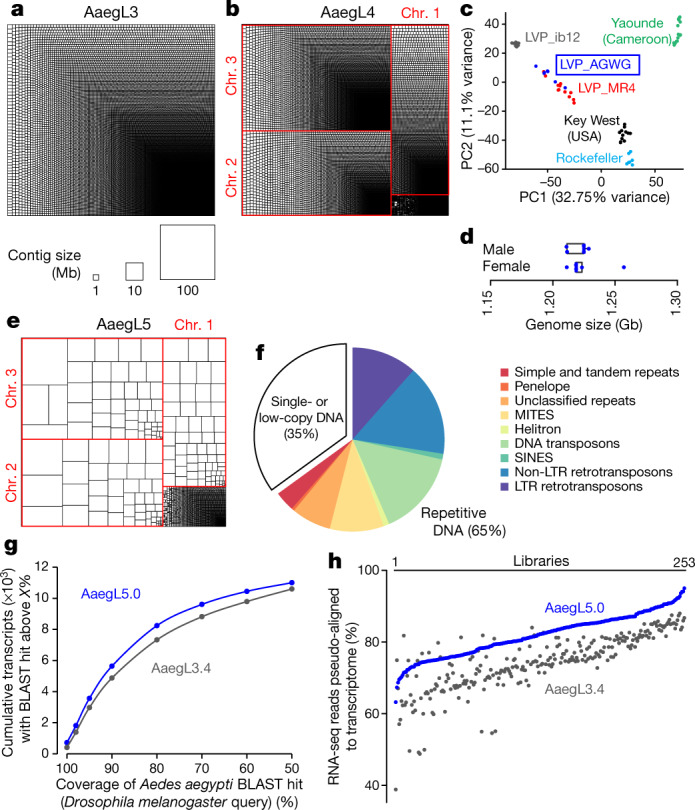
According to the paper, the lack of a high-quality genome assembly had held back work on mosquito biology. It had also slowed the development of tools to fight the insects. A genome assembly is an organism's DNA sequence pieced together in the right order. The team anchored AaegL5 to physical and cytogenetic maps. Those maps show where stretches of DNA sit on the mosquito's chromosomes.
With the new sequence, the number of known chemosensory ionotropic receptors doubled. These chemical-sensing proteins guide mosquitoes to human hosts and to egg-laying sites. The authors also report further insight into the size and composition of the M locus, the stretch of DNA that determines sex in this species.
Some findings concern insecticides. The assembly revealed copy-number variation among glutathione S-transferase genes, which are important for insecticide resistance. Copy-number variation means one mosquito can carry more copies of a given gene than another. The researchers also ran high-resolution quantitative trait locus analysis, a method that ties regions of DNA to a measurable trait, together with population genomic analyses. From that work they mapped new candidates for insecticide resistance. They mapped new candidates for dengue vector competence too, meaning a mosquito's ability to pick up and pass on the dengue virus.
The paper's title says the genome informs arbovirus vector control. That is the effort to curb the insects that spread viruses such as dengue and Zika. The authors expect AaegL5 to "catalyse new biological insights and intervention strategies to fight this deadly disease vector."