
Most human nucleosomes showed more consistent positioning than expected by chance
Most nucleosomes, the units that package DNA, occupied more consistent positions than expected by chance in seven human lymphoblastoid cell lines, cultured cell lines derived from human white blood cells. Researchers mapped over 3.6 billion DNA fragments and found that 8.7% of nucleosomes had moderate to strong positioning. Their study, “Controls of nucleosome positioning in the human genome,” was published in PLoS Genetics on 15 November 2012. They estimated that almost half of the genome contained regularly spaced nucleosome arrays, with these arrangements more common in active chromatin, the material made up of DNA and associated proteins.
Nucleosome arrangement can control which proteins bind to DNA, making it important for gene regulation. Previous results suggested that few human nucleosomes occupied consistent positions across cells. The limited resolution of existing data, however, had made that difficult to assess.
The researchers used micrococcal nuclease, an enzyme that cuts chromatin, then sequenced both ends of the resulting DNA fragments. They mapped the fragments to the human genome to produce what they described as the highest-resolution map of nucleosome occupancy then available in a human cell type. Most nucleosomes showed more consistent positioning than chance would predict, contrary to previous results.
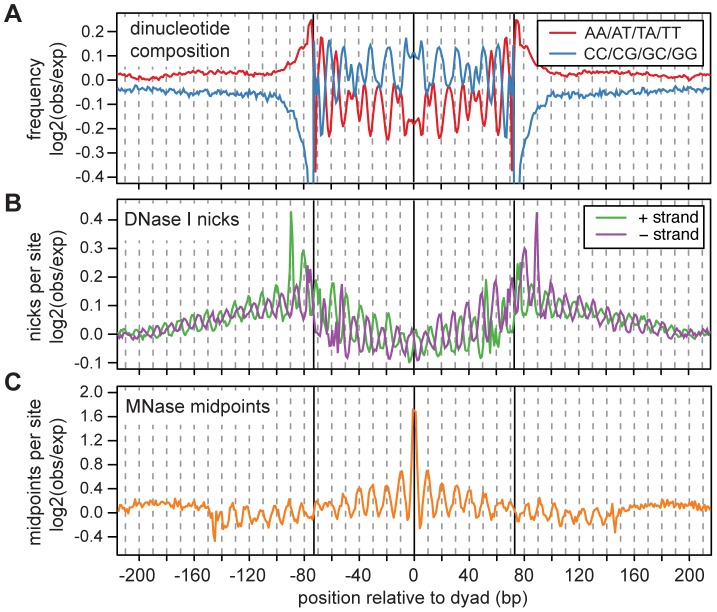
When the researchers examined nucleosome sequences together, they found repeating patterns in the frequency of two-letter DNA combinations at intervals of 10 bp, or DNA base pairs. Sensitivity to DNase I, another DNA-cutting enzyme, also followed a 10 bp pattern. Across cells, nucleosome positions frequently differed by multiples of 10 bp.
Single-letter DNA variants that reduced sensitivity to DNase I could disrupt the alignment of nucleosome arrays. This indicated that the arrays often formed against barriers made by other proteins, which constrained where the nucleosomes could sit.
DNA sequence alone could also create arrays. On chromosome 12, repeated copies of sequences with strong positioning properties produced an array of over 400 nucleosomes. The study found different controls in different regions: some nucleosomes occupied favored positions in the DNA sequence, while others were forced into specific arrangements by proteins that bind DNA or remodel its packaging.