
Custom PCR products used to capture 46 human mitochondrial genomes at once
Forty-six complete human mitochondrial genomes were captured in parallel and sequenced together on a single lane of an Illumina GA(II) instrument, according to a study published in PLoS One on 16 November 2010. T. Maricic, M. Whitten and S. Pääbo used custom made long-range PCR products to pull the complete genomes out of complex DNA mixtures. They described the method as "economical and simple". It is aimed at targets a few kilobases long, a size the authors said most existing enrichment methods did not suit.
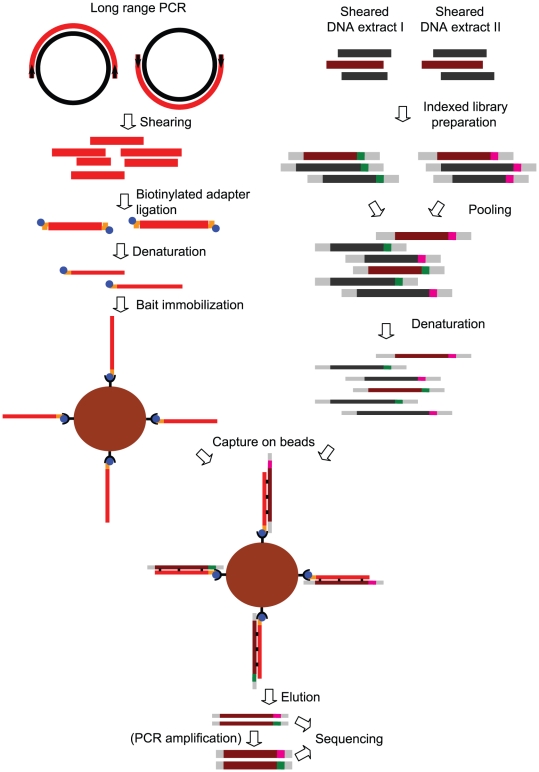
Mitochondria are the structures inside cells that produce energy, and they carry their own small genome, known as mtDNA. PCR is a laboratory technique for making many copies of a chosen stretch of DNA. Long-range PCR does the same for longer stretches. In this study the copies were not the end product. They served as the capture material, picking matching mitochondrial DNA out of complex DNA mixtures.
Capture, also called target enrichment, separates out the DNA of interest before sequencing. A high-throughput sequencer, a machine that reads very large amounts of DNA at once, can then spend its capacity on the target. The paper says most enrichment methods then available required reagents and equipment that only commercial vendors supplied. This one makes its capture material from custom made PCR products instead.
Multiplexed means many samples are handled together. Here all 46 genomes were sequenced side by side on one lane of the Illumina GA(II) instrument. The authors called their approach a novel and economical method for capturing complete human mitochondrial genomes.
The authors wrote that the method is particularly suitable for targets that can be amplified by PCR and do not contain highly repetitive sequences, and they gave mtDNA as an example. Highly repetitive sequences are stretches in which the same short pattern of DNA letters recurs many times. As for uses, they pointed to population genetics, which compares DNA across human groups, and to forensics, as well as studies of ancient DNA.