
Deleting Y chromosome DNA turned male garden asparagus into female plants
Removing a stretch of DNA found only on the Y chromosome turned male garden asparagus into female plants. Losing one gene within that stretch instead produced plants with both male and female reproductive organs. The findings, published in Nature Communications on 2 November 2017, supported a model in which two separate but linked genes determine sex: one suppresses female development, while the other is involved in male fertility.
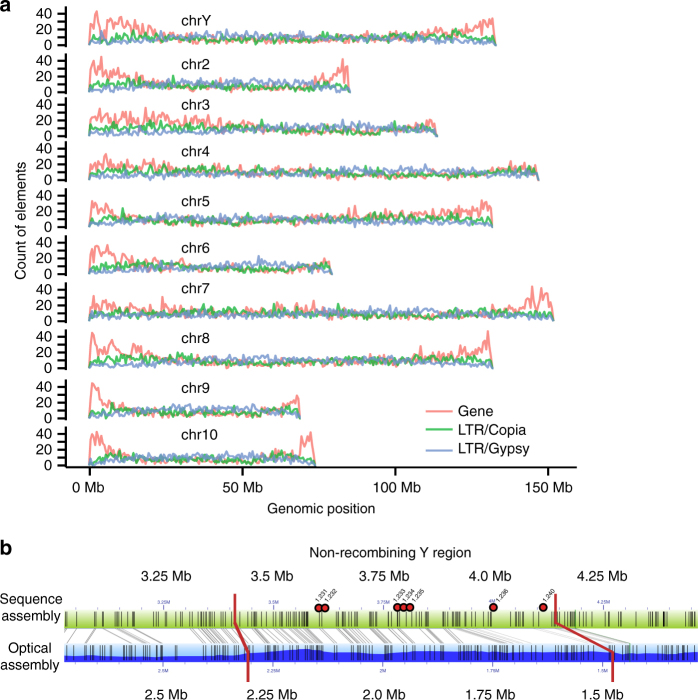
The researchers compared DNA sequences and carried out experiments using a reference genome assembled from a male garden asparagus (Asparagus officinalis L.) plant carrying two identical Y chromosomes. A reference genome provides a mapped DNA sequence against which researchers can compare other sequences.
Separate male and female plants evolved recently within Asparagus, making it a subject for studying young sex chromosomes. Its X and Y chromosomes look identical under a microscope. At the DNA level, however, the Y carries a megabase segment, a stretch of about a million DNA building blocks, that the X lacks. The deletions that changed the plants' sex affected this Y-specific region.
Alongside the gene that suppresses female development, the region contained a single copy of a gene active specifically in anthers, the pollen-producing parts of flowers. Disabling the corresponding gene in Arabidopsis caused male sterility. The evidence for this gene's role therefore came from its activity in asparagus anthers and a gene-disabling experiment in Arabidopsis.
The wider question is how sex chromosomes arise from ordinary chromosomes. That transition has happened many times across organisms whose cells contain a nucleus. Several models seek to explain it. Some involve mutations affecting male and female fertility that remain linked within a chromosome region where the paired sex chromosomes no longer exchange DNA. The asparagus study combined a comparison of the X and Y with experiments on the Y-specific segment to examine that proposed route.