
Honey bee queen and worker brains showed different DNA methylation patterns
Over 550 genes showed significant differences in brain DNA methylation between honey bee queens and workers in a study published in PLoS Biol. on 2 November 2010. DNA methylation adds chemical marks to DNA. Lyko F and colleagues mapped these marks in Apis mellifera and found a strong correlation between their patterns and sites where gene messages were spliced, or cut and joined. They proposed that changes in this process could link methylation to the regulation of genes in honey bees.
Queens and workers share the same genome but differ in behaviour and reproduction. Their distinct forms arise through different intake of royal jelly in concert with DNA methylation. The researchers examined whether these diet-controlled differences were also associated with different patterns of chemical marks in their brains.
The team used shotgun bisulfite sequencing, a method that locates methylated cytosines, or chemically marked DNA letters, across the genome. It mapped the marks at the resolution of individual DNA letters. The researchers checked the whole-genome results with deeper sequencing of selected regions from eight methylated genes.
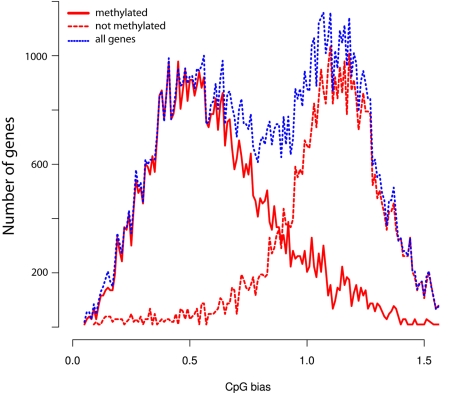
Nearly all the marks occurred at CpG sites, where the DNA letters C and G sit together, within exons. These are gene sections retained in processed gene messages. The marks appeared in 5,854 genes whose sequences were more conserved than those of genes without methylation. Genes with different methylation patterns in queens and workers had intermediate densities of CpG sites, between those of methylated genes with very few such sites and non-methylated genes with more.
The proposed link to gene regulation involved alternative splicing, in which different sections of a gene's message can be retained to produce different versions. The team found a strong correlation between methylation patterns and splicing sites, including sites with the potential to generate alternative exons.
A detailed examination of two message variants from one differentially methylated gene supported the genome-wide analysis. Differences in methylation among genes in the histone gene family provided further support for the proposed link with splicing.