
DNA outside cells triggered antibiotic resistance in Pseudomonas aeruginosa biofilms
DNA surrounding bacterial cells triggered resistance to certain antibiotics in Pseudomonas aeruginosa biofilms, communities of bacteria attached to surfaces. In a study published in PLoS Pathogens on 21 November 2008, Mulcahy, Charron-Mazenod and Lewenza found that DNA bound positively charged ions and activated resistance genes. Resistance increased by up to 2560-fold against cationic antimicrobial peptides, positively charged molecules that kill bacteria, and 640-fold against aminoglycoside antibiotics. Activation of the same genes had no effect on resistance to beta-lactams and fluoroquinolones, two other antibiotic classes.
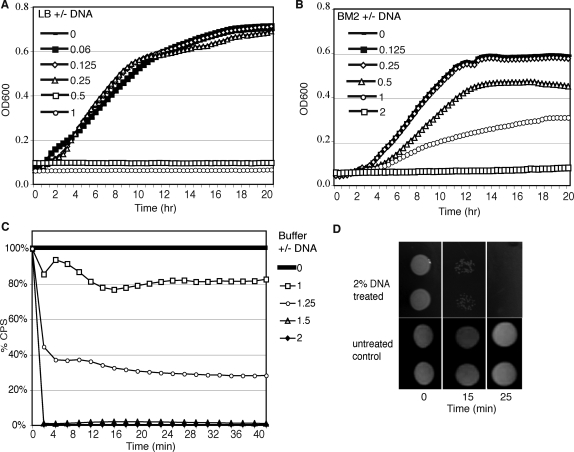
Biofilms are enclosed in material containing DNA, proteins and bacterial sugars. These communities can be up to 1000-fold more resistant to antibiotics than free-floating bacterial cultures. DNA outside the cells was already known to help maintain the structure of Pseudomonas aeruginosa biofilms. The experiments found that it also affected bacterial survival and resistance, with its effects depending on concentration.
At concentrations relevant to biological conditions, DNA outside the cells killed bacteria by binding positively charged ions that stabilize the outer membrane and lipopolysaccharide, a component of that membrane. Killing involved disruption of both the outer and inner membranes. Cells broke open within minutes and released their contents, including genomic DNA, which carries their genetic information.
Lower concentrations of DNA did not inhibit bacterial growth. Instead, they bound enough positively charged ions to create a shortage around the bacteria. Those conditions activated PA3552-PA3559, a group of resistance genes controlled by the bacterial regulatory systems PhoPQ and PmrAB. Activation increased resistance to cationic antimicrobial peptides and aminoglycosides. DNA surrounding the cells therefore did more than hold the biofilm together: by changing the availability of these ions, it triggered resistance to particular antimicrobials.
The authors suggested that DNA-rich environments, including biofilms and infection sites such as the lungs of people with cystic fibrosis, were likely places where P. aeruginosa encountered this shortage of positively charged ions.