
Three sorghum lines yield nearly 1,500 genes separating sweet from grain types
Researchers resequenced three inbred lines of Sorghum bicolor, two sweet and one grain, and identified a set of nearly 1,500 genes that differentiate sweet and grain sorghum. The study was published in Genome Biology on 21 November 2011. Its comparison covered only those three lines. L.Y. Zheng is the paper's first author and H.C. Jing its last. Inbred lines are plants bred over generations to be genetically uniform. Resequencing means reading the whole genome of further plants from a species that has already had one genome sequenced. The authors described the work as the first report of genome-wide patterns of genetic variation in sorghum.
Sorghum is grown around the world for food, animal feed, fiber and fuel. Sweet and grain types differ in several important traits. Stem sugar and juice build up differently in the two, and they also differ in plant height and in grain and biomass production. A full genome of one grain sorghum had already been sequenced. But the authors wrote that more genomes were needed to study variation within the species and work out the genetic basis of these traits, which would also support tailor-designed breeding.
The genes that set the sweet and grain lines apart fell into ten major metabolic pathways. Among them were sugar and starch metabolism, the making of lignin (the tough material that stiffens plant cell walls) and coumarin (a fragrant plant compound), nucleic acid metabolism, stress responses and DNA damage repair.
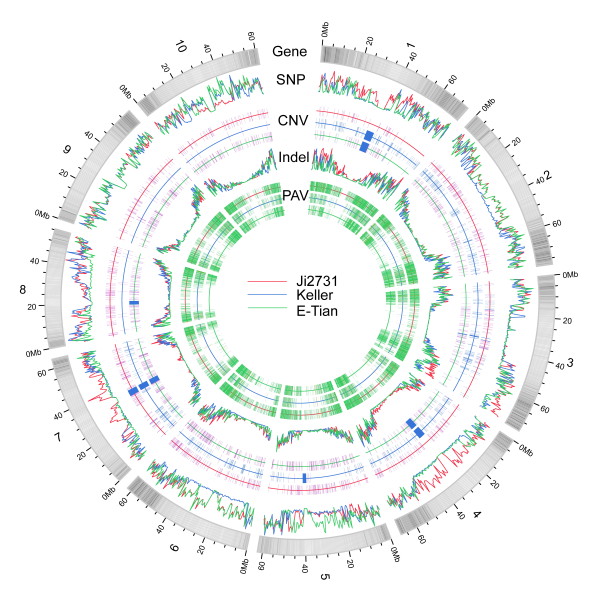
The team counted 1,057,018 SNPs, single-letter differences in the DNA code. They found 99,948 indels as well, small insertions or deletions 1 to 10 letters long. There were also 16,487 presence/absence variations, stretches of DNA that some lines carry and others lack, and 17,111 copy number variations, where a segment appears a different number of times. Most of the large-effect SNPs, indels and presence/absence variations turned up in disease resistance R genes and in genes containing leucine rich repeats or PPR repeats, two kinds of repeating segment in proteins. These genes had diverse biological functions or were under diversifying selection, meaning evolution favoured variety in them. Those large-effect variations were absent from genes essential for life.
The paper said the high-density SNP and indel markers would be a valuable resource for future gene-phenotype studies, which link DNA differences to observable traits. The authors also pointed to molecular breeding of sorghum and related species, in which plants are selected using their DNA.