
MIG-seq used PCR to genotype DNA variants without restriction enzymes
Thousands of regions scattered across a genome were copied and sequenced without restriction enzymes, using a method published in Scientific Reports on 23 November 2015. Its authors, Y. Suyama and Y. Matsuki, named it MIG-seq, short for multiplexed ISSR genotyping by sequencing. The method relied on PCR, a routine laboratory technique for copying stretches of DNA. With it they found single-nucleotide polymorphisms, which are single-letter differences in DNA between individuals, and genotyped them on next-generation sequencing machines. They needed no prior genetic information about the organism.
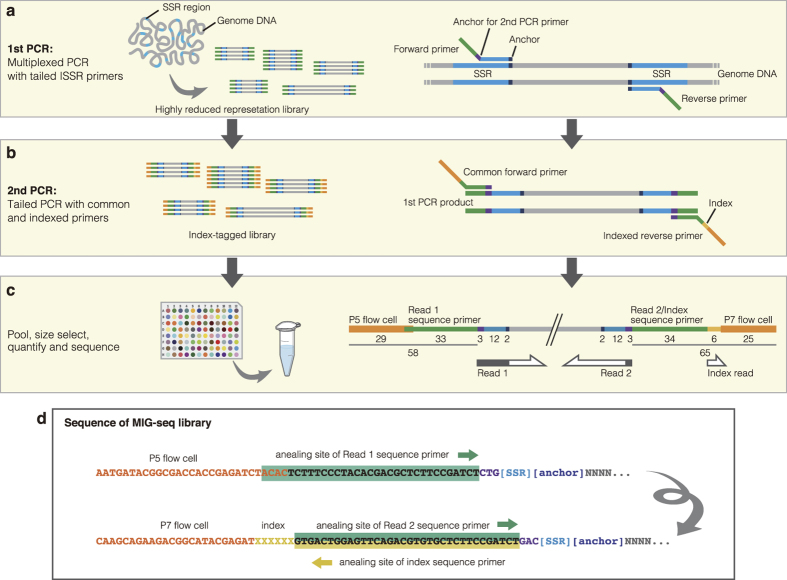
Restriction enzymes are proteins that cut DNA wherever a particular short sequence appears. The authors wrote that sequencing methods built on these enzymes had transformed marker-assisted genetic studies, in which DNA variants serve as markers. But the enzyme step had kept those methods from wider use. Field samples were the hardest case, because their DNA is often of low quality or available only in small amounts.
MIG-seq did away with the enzyme step. PCR built what is called a reduced representation library instead: a collection of selected regions from across the genome rather than the full sequence. Copying started from ISSR primers. These are short pieces of DNA that bind to simple repeats, runs such as CACACA where a few letters recur, and mark the starting points for copying the DNA that lies between them. Many primers worked at once, which is the "multiplexed" part of the name. The paper reported that this amplified thousands of regions effectively from a wide variety of genomes.
The authors tested the method in several ways. Variants it discovered passed into sex cells as Mendel's rules of inheritance predict, with each sex cell receiving one of a parent's two copies. To check whether genotyping was reproducible, they used it to tell individuals apart. Standard population genetic analyses also worked when applied across a wide variety of species.
Suyama and Matsuki concluded that the approach should be applicable to many marker-assisted genetic studies with a wide range of DNA qualities and quantities.