
Arabidopsis metabolite study found genetic links shifted with environmental conditions
Tests of 327 metabolites against >200,000 single nucleotide polymorphisms, single-letter differences in DNA, found numerous links between genetic variation and metabolite levels in wild Arabidopsis thaliana plants. Those links clustered in particular parts of the genome and were sensitive to environmental fluctuations. Published in PLoS Genet on 4 November 2010, “The complex genetic architecture of the metabolome” examined variation in plant metabolism, the chemical processes within organisms. Its authors, Chan EK, Rowe HC, Hansen BG, Kliebenstein DJ, concluded that studies mapping genetic differences within a species would need to examine how genes and environmental conditions interact.
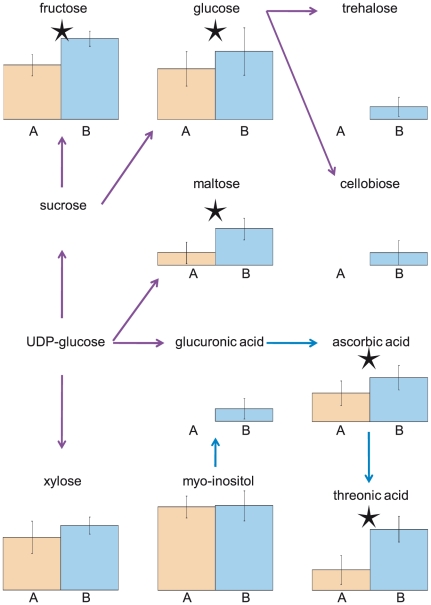
The researchers surveyed metabolites, substances involved in metabolism, without restricting their measurements to a predetermined set. They used the results in a genome-wide association study: a search across the plants' DNA for statistical links between genetic differences and measured traits. The plants came from a collection of wild Arabidopsis thaliana lines.
Some clusters of genetic links to metabolite levels, called hotspots, overlapped regions previously identified as having undergone recent strong positive selection. This occurs when selection favours particular genetic variants, leaving a pattern known as a selective sweep. Other hotspots showed genetic links to those suspected sweep regions elsewhere in the genome. The pattern suggested that these selective forces had affected the control of metabolism across the genome.
The team also compared the wild collection with a laboratory population bred from two of its lines. Although the wild plants had more genetic variation, they did not show greater variation in their measured metabolite levels. The researchers interpreted this as evidence suggesting that evolutionary constraints limited metabolic variation.
The environmental effects extended beyond individual links between DNA and metabolites. Across multiple independent experiments, environmental differences also affected the network of links among metabolites, suggesting that key aspects of its organisation were flexible. Cataloguing genetic variation within a species would therefore require more than a list of associations: researchers would need to analyse how genetic differences and environmental conditions worked together.