
Genome scan of 129 peach accessions sharpens DNA signals for fruit traits
A study published in Nature Communications on 8 November 2016 used whole-genome sequences from 129 peach accessions to look for DNA linked to 12 agronomic traits. Ten of those traits were qualitative. For nine of them, the authors reported association signals that were consistent and more precise than those found earlier by linkage analysis. The work also turned up two candidate genes. One, potentially involved in cell death, was highly associated with fruit shape. The other is predicted to encode an auxin-efflux carrier, a protein that moves the plant hormone auxin out of cells, and was highly associated with non-acidity.
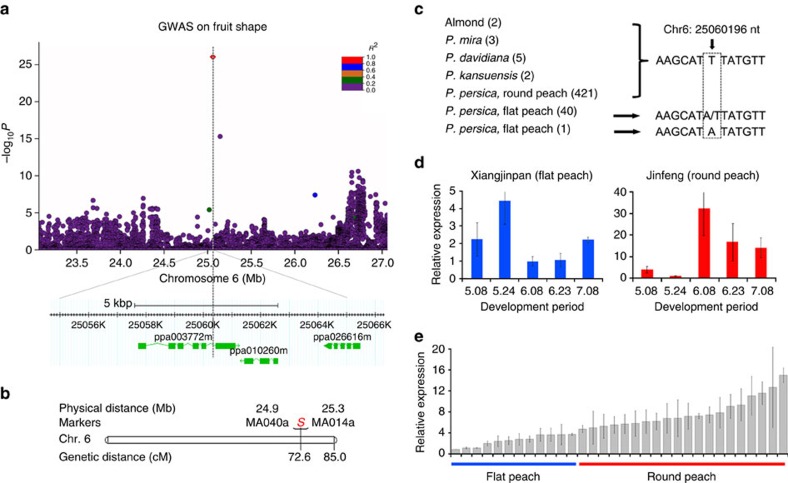
A genome-wide association study compares DNA across many individuals. It looks for places where a particular variant shows up more often in those that carry a given trait. Here the individuals were 129 peach accessions, distinct peach lines whose whole genomes had been sequenced. Agronomic traits are the characteristics that matter when growing a crop. Qualitative traits fall into categories rather than along a scale. Fruit shape is one of them, and non-acidity, meaning fruit low in acid, is another. Linkage analysis, the older method the new signals were measured against, follows how traits pass down through related plants.
Fruit weight and soluble solid content pointed back to the crop's history. Soluble solid content is a measure of the sugars and other substances dissolved in the fruit. Several genomic regions carrying association signals for these two traits overlapped with predicted selective sweeps. A selective sweep is a stretch of DNA where variation has narrowed because one version was favoured. These sweeps were predicted to have occurred during peach domestication and improvement.
Peach, Prunus persica, is a highly valuable crop, and molecular researchers regard it as a model fruit for the Rosaceae, the rose family of plants. The paper lists 12 authors, with Cao K first and Wang L last. They described their findings as a contribution to the large-scale characterization of genes that control agronomic traits in peach.