
Worm sequencing strategy traced excess dopamine neurons to vab-3 mutation
A combined DNA sequencing and genetic mapping strategy identified a mutation in vab-3 in Caenorhabditis elegans worms that produced excess dopamine-producing nerve cells. Doitsidou M and colleagues reported the proof of principle in PLoS One on 8 November 2010. The approach folded the work of locating a mutation into the procedure for reading the worm's whole genome. The authors said it would shorten the time between isolating a mutant and identifying the DNA change responsible for its trait.
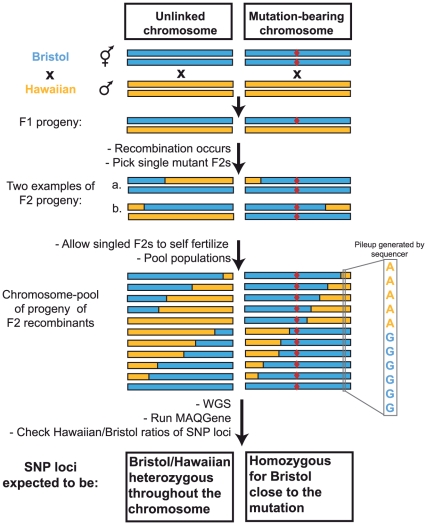
Reading a mutant worm's genome does not necessarily reveal which mutation causes an observed trait. Strains produced through mutation experiments carry many DNA changes. Researchers often still need to narrow the search to a stretch of chromosome to distinguish the responsible mutation from the other sequence differences.
The team used inherited DNA markers to make that search part of the sequencing procedure. They crossed a mutant worm retrieved from a genetic screen with a genetically different Caenorhabditis elegans strain. The strains differed at single nucleotide polymorphisms, or SNPs: variations at individual positions in the DNA. From the second generation of the cross, called F2, they selected individual worms showing the mutant trait. They then pooled the offspring of those selected worms and sequenced their whole genomes together.
A local drop in the density of SNP markers supplied the clue. Markers from the genetically different strain were less common around the DNA change responsible for the trait. That pattern allowed the researchers to locate the relevant region and identify the mutation in the sequencing data.
To test the strategy, the team examined a mutant strain that produced excess dopaminergic neurons, nerve cells that make dopamine. They traced the mutation to vab-3, the worm counterpart of Pax-6/Eyeless. This was the proof of principle for combining genetic mapping with whole-genome sequencing in the same procedure.