
APOE-stratified Alzheimer study flags nine loci missed by standard analysis
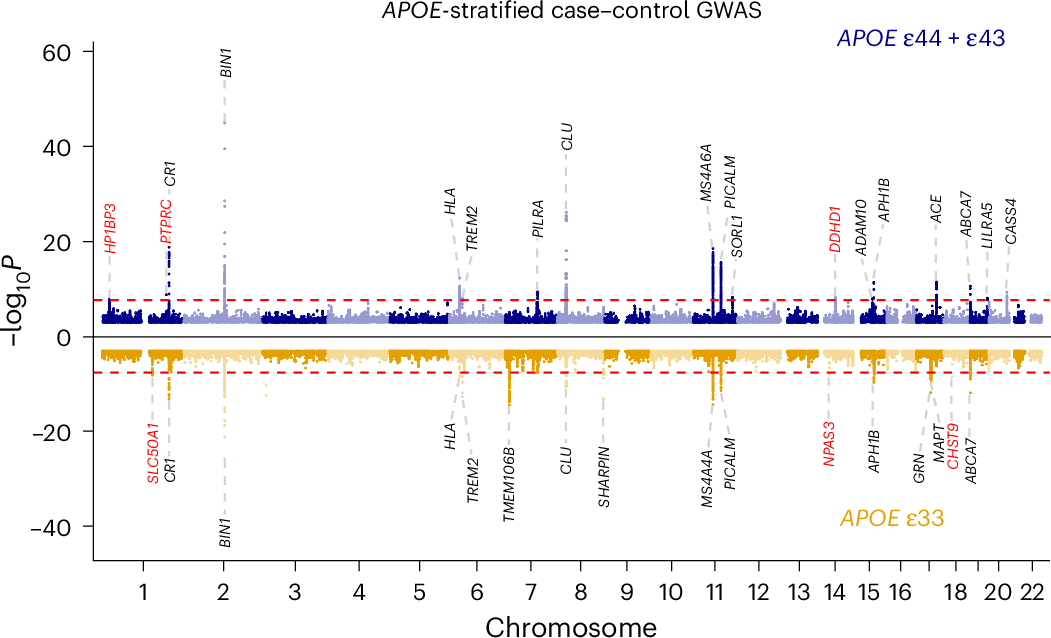
Nine genetic risk loci for late-onset Alzheimer disease and related dementias show up only when genome-wide association analyses are split by APOE ε2/ε3/ε4 carrier status, according to a paper in Nature Genetics. The signals -- HP1BP3, SLC50A1, PTPRC, NPAS3, DDHD1, CHST9, SMYD2, PRAMEF1 and GFRA1 -- were invisible in unstratified runs. DDHD1 stood out: it showed protective effects in ε4 carriers, has been flagged as an expression quantitative trait locus, and is tied to rare neuronal diseases. The work drew on a large meta-analysis pulling together European, Asian, Asian American, African American and admixed American ancestry cohorts. Recent anti-amyloid trials have shown lower efficacy and higher rates of severe side effects in ε4 carriers, and the authors argue that APOE-stratified designs could help explain those patterns, refine trial enrollment, and point toward mechanism-driven therapy targets.
Variant signals tied to specific APOE subgroups give neurologists and trial designers a finer map of disease architecture. For the ε4 carriers who respond poorly to current anti-amyloid therapies, loci like DDHD1 may eventually anchor more targeted approaches to enrollment and mechanism research.
Written by the Genomes desk from the primary source cited and linked above and checked against it. Research use only; not medical advice. Corrections: [email protected].