
Human, chimpanzee and bonobo genomes share an ancient population size peak
For over a decade, computational biologists reconstructing the demographic history of hominins have relied on coalescent methods like the Pairwise Sequentially Markovian Coalescent (PSMC) model, pioneered by study co-author Richard Durbin in 2011. By examining patterns of heterozygous single-nucleotide variants across a single diploid genome, researchers can estimate how effective population size (Nₑ) fluctuated over thousands of generations. However, standard short-read reference assemblies suffered from severe mapping ambiguity across highly repetitive satellite DNA, telomeres, and centromeric heterochromatin. As a consequence, statistical power deteriorated rapidly beyond two million years ago, leaving the critical evolutionary window when our direct ancestors parted ways with the chimpanzee and bonobo lineage (Pan) obscured in genomic fog.
In a new study published in the peer-reviewed journal GENETICS, computational geneticists Trevor Cousins, Richard Durbin (University of Cambridge and Wellcome Sanger Institute), and Regev Schweiger overcome this barrier by deploying long-read, gapless telomere-to-telomere (T2T) assemblies. By analyzing continuous, unfragmented chromosomal sequence data across humans and non-human great apes, the researchers extended the horizon of coalescent-based demographic inference three times further into the past than previously possible, reliably querying deep population history from two to six million years ago.
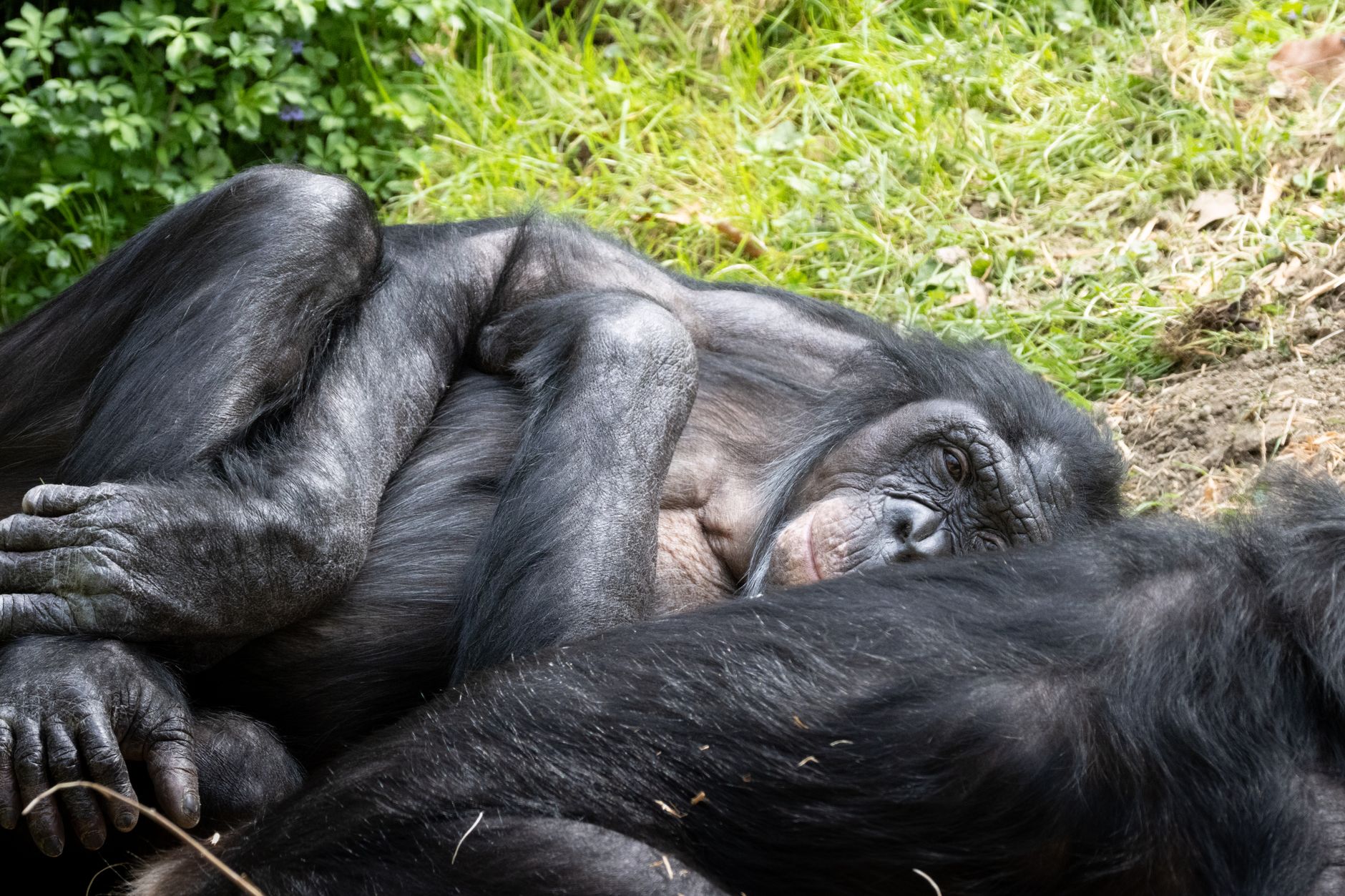
When the team applied their enhanced coalescent framework to modern human genomes, an unexpected signal emerged: a dramatic, prominent peak in effective population size between three and six million years ago. Even more remarkably, when the authors ran the identical inference on gapless assemblies of chimpanzees (Pan troglodytes) and bonobos (Pan paniscus), both sister species exhibited an almost identical demographic surge over the exact same geological time window. Crucially, the signal vanished when analyzing outgroups: western lowland gorillas (Gorilla gorilla) and Sumatran orangutans (Pongo pygmaeus) showed no such elevation, proving the phenomenon is specific to the Homo-Pan clade and cannot be explained by generic computational distortions, assembly biases, or primate-wide mutation rate shifts.
In theoretical population genetics, an apparent increase in effective population size does not necessarily mean that the physical census count of hominins suddenly multiplied across Africa. Rather, mathematical models of structured coalescence demonstrate that an apparent spike in Nₑ is the canonical signature of ancestral population subdivision. When divergent subpopulations exchange migrants at modest rates, coalescence times between alleles sampled from different groups are significantly prolonged. In demographic algorithms assuming a single, panmictic breeding population, this extended coalescence time is mathematically interpreted as a massive surge in effective population size.
These findings challenge the traditional 'clean-split' paradigm of human evolution, which depicts modern human and chimpanzee lineages branching neatly and instantaneously from a single, well-mixed common ancestral pool. Instead, the contemporaneous peaks across Homo, chimpanzee, and bonobo point directly toward an extended period of complex speciation. Between three and six million years ago, ancestral hominin populations likely diverged into geographically or ecologically distinct demes, accumulated distinct genetic adaptations, and intermittently hybridized through recurring gene flow before permanent reproductive isolation was finally established.
The study underscores how telomere-to-telomere genomics is reshaping our understanding of deep evolutionary time. By resolving previously intractable regions of great ape chromosomes, computational geneticists are transforming human evolutionary history from a static, branching tree into a dynamic, reticulate tapestry of interconnected ancestral populations.
Written by the Genomes desk from the primary source cited and linked above and checked against it. Research use only; not medical advice. Corrections: [email protected].