
MANTIS estimated survival and radiation effects in childhood brain tumors
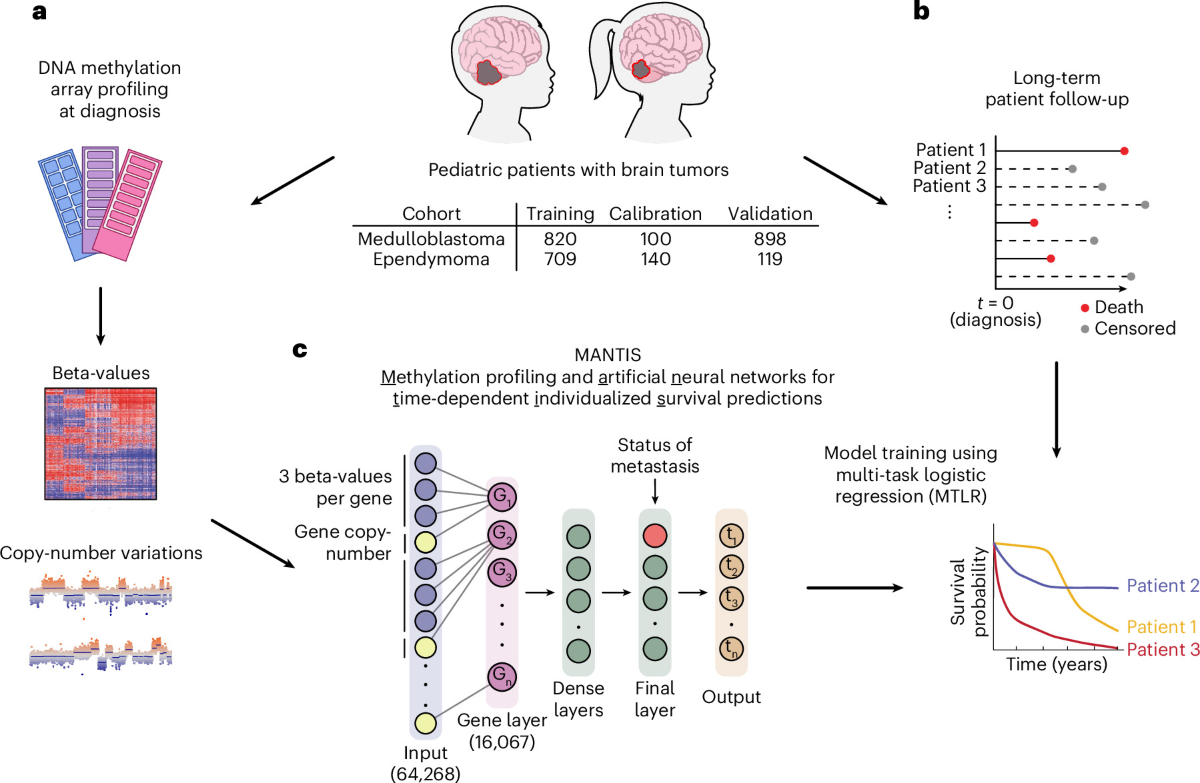
An AI model called MANTIS estimated that ~60% of patients with average-risk medulloblastoma belonged to a group with no significant survival disadvantage at lower radiation doses (P = 0.683). The analysis estimated treatment effects using randomized clinical trial data. Stefan and colleagues reported in Nature Genetics that MANTIS used DNA methylation data from 2,786 patients to estimate individual survival probabilities over a 10-year period for medulloblastoma and ependymoma, two of the most common childhood brain tumors. Predictive performance reached a concordance index of 0.80 ± 0.07, a measure of how well predictions rank patients' survival outcomes. MANTIS significantly exceeded the predictive accuracy of current clinical indicators.
Lower radiation doses are associated with better cognitive outcomes. Craniospinal irradiation, radiation treatment covering the brain and spinal cord, is associated with cognitive decline influenced by dose and age at treatment. The researchers developed MANTIS to help weigh the risk of tumor recurrence and death against severe, long-lasting treatment effects.
The model draws on genome-wide DNA methylation profiles, measurements of chemical marks on DNA already used to classify brain tumors. Its inputs included >350,000 measurement sites and inferred changes in the number of copies of genes. During training, it also used survival follow-up recorded for the same patients. An internal layer represented 16,067 genes, organizing the molecular information by gene and reducing the number of parameters the model had to learn.
MANTIS estimated the probability of an event occurring within successive time intervals rather than assigning patients to a single outcome category. That allowed it to use records in which follow-up ended before an outcome was observed. It could also account for molecular features whose relationship with survival changed over time.
For the radiation analysis, the team used methods designed to distinguish treatment effects from other influences. Some earlier attempts to reduce radiation doses were unsuccessful across whole patient groups. The authors argued that those results may conceal differences between patients, with lower doses still appropriate for selected individuals. More recent approaches informed by tumor biology, including the SJMB12 and PNET5 clinical trials, have shown encouraging preliminary results.
DNA methylation profiling already helps classify brain tumors, but its use in predicting individual outcomes remains underexplored. Many patients relapse without established high-risk features. MANTIS was developed to draw on information in methylation profiles beyond existing tumor classifications to estimate how survival probabilities vary between patients.
Written by the Genomes desk from the primary source cited and linked above and checked against it. Research use only; not medical advice. Corrections: [email protected].