
PHERGain reports 89.5% 5-year invasive disease-free survival with response-guided treatment
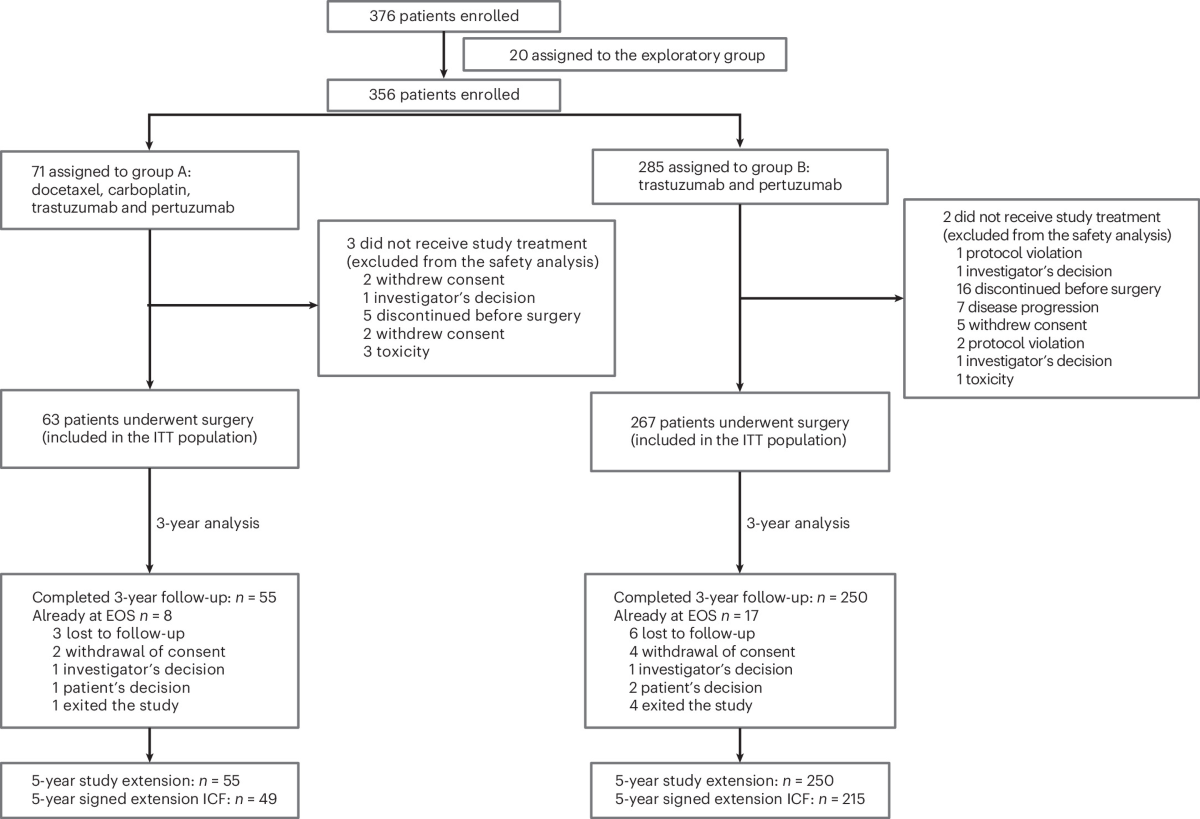
The PHERGain breast cancer trial reported 5-year invasive disease-free survival of 89.5% among 267 women in its adaptive treatment group who underwent surgery according to protocol. This measure counts invasive cancer events or death, including second cancers outside the breast. The secondary analysis, published in Nature Medicine, examined a strategy designed to spare selected patients with HER2-positive early breast cancer from chemotherapy. PHERGain was a randomized, non-comparative phase 2 trial: it was not designed to establish whether the adaptive strategy matched standard treatment. The 89.5% estimate therefore does not establish equivalent outcomes with less chemotherapy.
HER2-positive cancers have extra copies of the ERBB2 gene or produce excess HER2 protein, which cancer drugs can target. PHERGain enrolled women with operable disease from stage I to stage IIIA, tumors measuring at least 1.5 cm and a breast lesion assessable by PET. Recruitment ran from 26 June 2017 to 24 April 2019.
Participants were randomized in a 1-to-4 ratio to standard treatment or an adaptive regimen. Standard treatment combined docetaxel and carboplatin chemotherapy with the HER2-targeting drugs trastuzumab and pertuzumab. The adaptive regimen began with trastuzumab and pertuzumab, with or without hormone therapy.
PET scans assessed tumor response after two cycles. Examination of tissue at surgery then determined whether patients had achieved a pathological complete response, meaning no remaining invasive cancer was detected. Patients whose tumors did not respond on PET scans, or who did not achieve a pathological complete response, also received docetaxel and carboplatin.
Median follow-up was 5.6 years. Among the 267 women in the adaptive group's surgery population, 26 (9.7%) had an invasive disease event or died within 5 years after surgery. Most events were distant recurrences (5.2%) and second primary non-breast cancer (1.5%). The 89.5% survival estimate had a 95% confidence interval of 85.7 to 93.4.
Among 86 women whose tumors responded on PET scans and who achieved a pathological complete response without chemotherapy, 5-year invasive disease-free survival was 92.4%, with a 95% confidence interval of 86.7 to 98.5. There was one distant recurrence. This subgroup was defined by responses measured after randomization, so its outcome was descriptive and did not establish the causal effect of omitting chemotherapy.
Follow-up participation also narrowed: of the 250 women in the adaptive group who completed the initial 3-year follow-up, 215 (86.0%) re-consented to the extension phase.
An exploratory blood analysis assessed Guardant Reveal, a test for circulating tumor DNA, fragments of tumor DNA found in blood. Detectable tumor DNA before or during treatment was associated with poorer invasive disease-free survival. Its clearance correlated with higher pathological complete response rates and better long-term outcomes.
The authors concluded that the results support the clinical validity of adapting treatment to PET response and tissue findings at surgery. They also suggested that circulating tumor DNA testing may help refine individual treatment decisions.
Written by the Genomes desk from the primary source cited and linked above and checked against it. Research use only; not medical advice. Corrections: [email protected].