
Egoviruses found in animal guts are closest known relatives of poxviruses
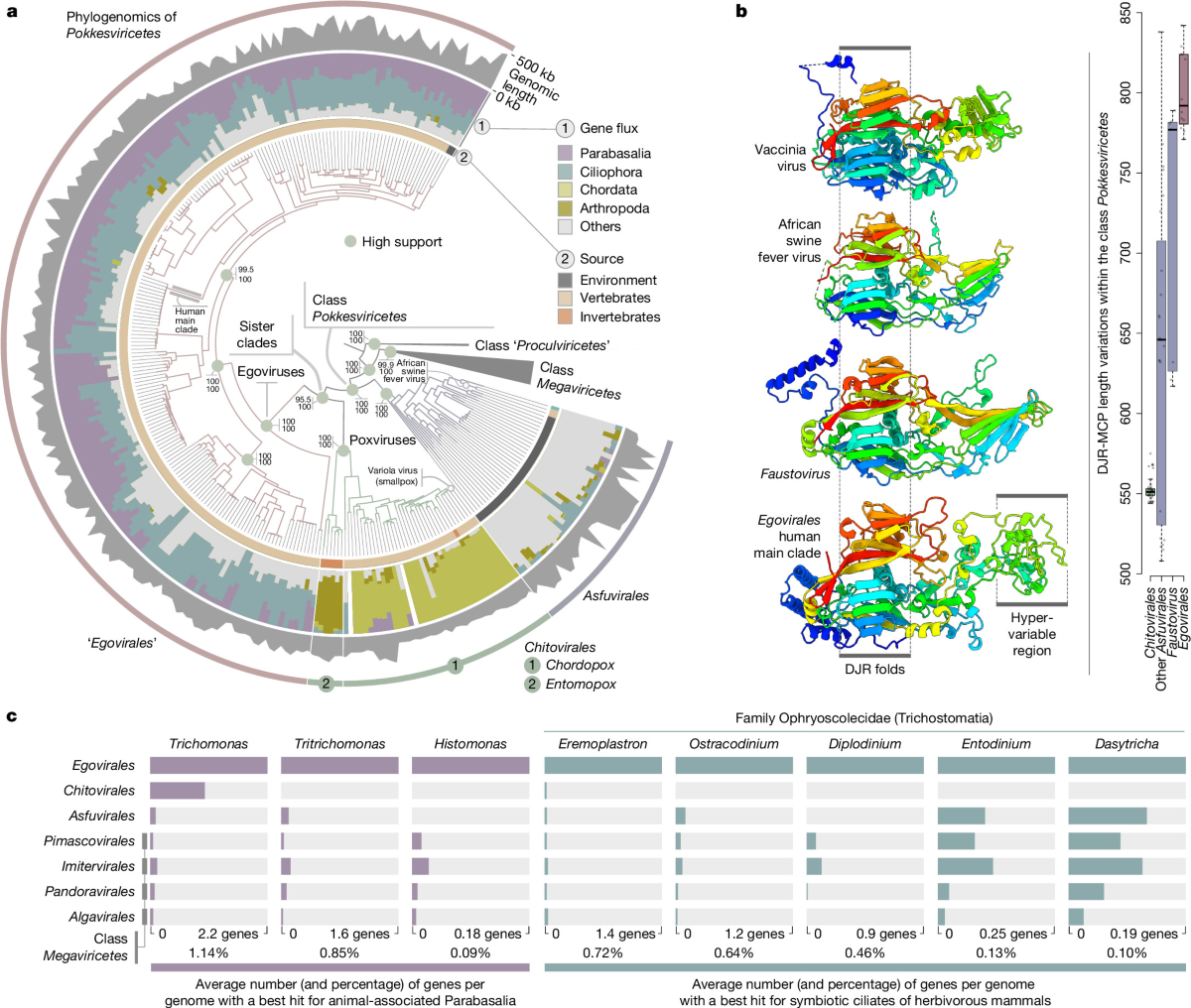
Researchers have identified egoviruses, a group of DNA viruses found worldwide almost exclusively in the digestive systems of humans, livestock and wild animals. Describing them in Nature as the closest known relatives of animal-infecting poxviruses, the team proposed a new viral order, Egovirales. The survey covered 85,123 metagenomic assemblies, collections of DNA sequences reconstructed from mixed samples. One egovirus population was estimated to be present in more than 1% of the human population across continents.
The researchers searched for a gene encoding part of RNA polymerase, the machinery that copies genetic information from DNA into RNA. Comparisons of this gene help trace evolutionary relationships. The search identified 1,969,342 genes for this part of RNA polymerase across cellular and viral groups. Using this gene and another encoding a protein shell component, the team detected egoviruses in 864 metagenomic assemblies. They also characterized 12 complete egovirus genomes from the digestive systems of humans, buffalo, goats, chicken, deer and pigs.
Genetic evidence suggested that egoviruses primarily infect single-celled organisms living in animal guts. Similar versions of core egovirus genes appeared in Trichostomatia, ciliates that assist digestion in ruminant animals, and Parabasalia, which influence animal immunity and the ecology of gut microbes. The shared genes suggested a long history of interactions between egoviruses and these organisms.
Egoviruses also contributed genetic material to polintons, viruses that insert themselves into host DNA. Those polintons multiplied within the genomes of Trichomonas vaginalis, a pathogen, and its close Parabasalia relatives. Similar versions of core egovirus genes occurred in these polintons as well as in the organisms themselves.
Comparisons of viral genes suggested that egovirus-like ancestors of poxviruses infected single-celled organisms living without oxygen inside ancestral animal guts before transitioning to animal cells. A lasting association inside the gut would have favoured that transition by allowing the viruses to adapt to the animal's internal environment.
The authors also predicted that egoviruses form multilayered, 20-faced protein shells around their genetic material. These resemble the shells of asfuviruses and probably represent the ancestral structure. Poxviruses form brick-shaped particles, a difference the authors linked to the proposed transition to infecting animal cells.
Earlier surveys had found no group of Nucleocytoviricota, a broad group of large DNA viruses, commonly associated with animal digestive systems. Egoviruses are among the most prevalent DNA viruses of eukaryotes, organisms whose cells have a nucleus, naturally occurring in animals. Their discovery points to gut-dwelling single-celled organisms as possible ancestral hosts of poxviruses. The proposed hosts rest on similarities between egovirus genes and genes in those organisms; the shell shape is a prediction from viral sequences recovered from mixed samples.
Written by the Genomes desk from the primary source cited and linked above and checked against it. Research use only; not medical advice. Corrections: [email protected].